
nj driving manual pdf
Category : Manuals
New Jersey Driving Manual PDF: A Comprehensive Guide (Updated March 14, 2026)
This comprehensive guide, updated today, March 14, 2026, offers crucial details regarding New Jersey driver licensing, testing, and safe driving regulations in a readily accessible PDF format.
The New Jersey Driving Manual serves as the official resource for all aspiring and current drivers within the state. This vital document, available as a PDF, meticulously outlines the requirements for obtaining a New Jersey driver license, detailing the necessary testing procedures and emphasizing safe driving practices. It’s a cornerstone for understanding New Jersey’s traffic laws and regulations, ensuring drivers are well-informed and prepared for the responsibilities of operating a vehicle.
This manual isn’t merely a compilation of rules; it’s a comprehensive guide designed to promote road safety for everyone. It covers essential topics, from understanding traffic signs and signals to navigating various driving conditions. The information contained within is regularly updated, with the current version reflecting changes as of March 14, 2026, ensuring drivers have access to the most current and accurate information available. It’s based on work supported by the Federal Motor Carrier Safety Administration.
Why Use the Official NJ Driving Manual PDF?
Utilizing the official New Jersey Driving Manual PDF is paramount for several reasons. Firstly, it guarantees access to the most accurate and up-to-date information regarding state-specific driving laws, regulations, and procedures. Unlike unofficial sources, the NJMVC-provided manual reflects the latest legislative changes, ensuring you’re studying current material;
Secondly, the PDF format offers unparalleled convenience – it’s readily accessible on various devices, allowing for study anytime, anywhere. This manual, copyrighted 2022 by AAMVA, is based on work supported by the Federal Motor Carrier Safety Administration. It’s crucial for preparing for both the knowledge and road tests, providing a solid foundation for safe and legal driving. Relying on the official manual minimizes the risk of misinformation and maximizes your chances of success, ultimately contributing to safer roads for all New Jersey drivers.
Where to Download the Official NJ Driving Manual PDF
The official New Jersey Driving Manual PDF is readily available for download directly from the New Jersey Motor Vehicle Commission (NJMVC) website. This is the most reliable source to ensure you obtain the current, authorized version – crucial as regulations are subject to change.
Accessing the manual is straightforward; navigate to the NJMVC’s official online portal and locate the “Driver Information” or “Publications” section. From there, you’ll find a direct link to download the PDF. Remember, this document, with copyright 2022 AAMVA, is supported by the Federal Motor Carrier Safety Administration. Avoid downloading from unofficial third-party websites to prevent accessing outdated or inaccurate information. Always verify you are on the official NJMVC site for the most dependable resource for your driver’s education needs.

Understanding New Jersey Driver Licensing
New Jersey offers diverse driver licenses, including learner permits and graduated licenses, detailed within the official manual for aspiring and current drivers alike.
Types of New Jersey Driver Licenses
New Jersey’s Motor Vehicle Commission (NJMVC) issues a variety of driver licenses to accommodate different needs and driving privileges. Basic driver licenses are the standard credential for fully licensed drivers, while learner permits allow individuals to practice driving under supervision. The Graduated Driver License (GDL) program features provisional licenses with specific restrictions for new drivers.
Commercial Driver Licenses (CDLs) are required for operating large commercial vehicles, with various endorsements for specific cargo or passenger transport. Additionally, the NJMVC offers non-driver identification cards for individuals who do not drive but require official photo identification. The official NJ Driving Manual PDF comprehensively details each license type, outlining eligibility requirements, application procedures, and associated fees. Understanding these distinctions is crucial for navigating New Jersey’s licensing system effectively.
Graduated Driver License (GDL) Program Overview
New Jersey’s Graduated Driver License (GDL) program is a multi-stage process designed to safely introduce new drivers to the road. It begins with a learner’s permit, requiring supervised driving practice. Next, a provisional license is issued with restrictions on nighttime driving and passenger limits. These restrictions gradually ease as the driver gains experience and maintains a clean driving record.
The NJ Driving Manual PDF provides a detailed breakdown of each GDL stage, including specific requirements for practice hours, testing procedures, and permissible driving conditions. Successful completion of each stage is essential before progressing to a full, unrestricted driver license. The program aims to minimize risks associated with inexperienced drivers, promoting responsible driving habits from the outset.
Special Learner Permits & Restrictions
The New Jersey Driving Manual PDF outlines various special learner permits available, catering to specific circumstances. These include permits for motorcycle learners and commercial learner permits, each with unique requirements and restrictions. Regardless of the permit type, all learner’s permit holders must be accompanied by a supervising driver who meets specific criteria, as detailed in the manual.
Restrictions commonly apply to learner permit holders, including limitations on driving hours (no unsupervised driving between 11:01 PM and 5:00 AM) and passenger limits. The manual clearly defines these restrictions and the penalties for violations. Understanding these rules is crucial for safe and legal driving practice during the learning phase, ensuring compliance with New Jersey law.

Preparing for the NJ Knowledge Test
The NJ Driving Manual PDF is your primary resource for mastering the knowledge test, covering vital traffic laws, signals, and safe driving practices for success.
Key Topics Covered on the Knowledge Test
The New Jersey knowledge test, comprehensively detailed within the official NJ Driving Manual PDF, assesses your understanding of crucial driving principles and state-specific regulations. Expect questions focusing on traffic laws, including speed limits, right-of-way rules, and proper lane usage. A significant portion evaluates your recognition of traffic signs and signals – from regulatory and warning signs to guide markers.
Furthermore, the test delves into safe driving practices, such as maintaining a safe following distance, proper turning procedures, and hazard perception. Understanding New Jersey’s laws regarding alcohol and drugs is paramount, as is knowledge of distracted driving regulations, particularly concerning cell phone use. The manual PDF also prepares you for questions related to pedestrian and cyclist safety, and emergency procedures. Thoroughly reviewing the manual ensures you’re well-equipped to demonstrate a solid grasp of these essential topics.
Practice Knowledge Test Questions & Resources
To effectively prepare for the NJ knowledge test, utilizing practice questions is invaluable. The official NJ Driving Manual PDF doesn’t directly include a full practice test, but numerous third-party resources offer simulated exams mirroring the test’s format and difficulty. These resources, readily available online, allow you to assess your understanding of the material and identify areas needing further study.
Many websites provide free practice tests, while others offer more comprehensive paid courses. Remember to verify the resource’s accuracy and ensure it aligns with the current NJ Driving Manual PDF (updated March 14, 2026). Focus on understanding the reasoning behind correct answers, not just memorizing them. Supplement these tests with a thorough review of the manual, paying close attention to sections on traffic laws, signs, and safe driving techniques. Consistent practice builds confidence and increases your chances of success.

Understanding Traffic Signs & Signals
The NJ Driving Manual PDF places significant emphasis on recognizing and interpreting traffic signs and signals, a critical component of the knowledge test. Signs are categorized by shape and color – regulatory, warning, and guide signs – each conveying specific instructions or information. Mastering these visual cues is paramount for safe driving.
The manual details the meaning of each sign, including those related to speed limits, lane usage, and potential hazards. Understanding traffic signals, including steady, flashing, and arrow indications, is equally vital. Pay close attention to the sections covering right-of-way rules at intersections and pedestrian crossings. Practice identifying signs and signals in various scenarios to reinforce your knowledge. Resources supplementing the PDF often include interactive quizzes focused solely on sign recognition, aiding in effective preparation.
Mastering the NJ Road Test
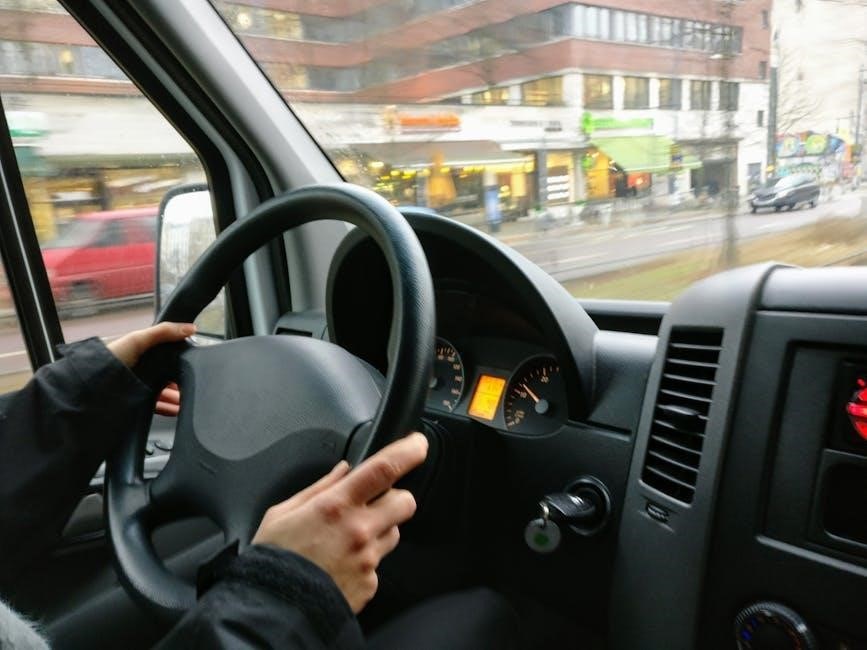
The NJ Driving Manual PDF thoroughly prepares drivers for the road test, detailing vehicle inspection requirements, common mistakes, and scoring criteria for evaluation.
Road Test Requirements & Vehicle Inspection
Successfully navigating the New Jersey road test demands meticulous preparation, and the official NJ Driving Manual PDF is your essential guide. Before even starting the engine, a comprehensive vehicle inspection is mandatory. This includes verifying operational headlights, brake lights, turn signals, and a functioning horn.
The examiner will scrutinize tire condition, ensuring adequate tread depth, and confirm the proper operation of windshield wipers. Documentation, like current registration and insurance, must be readily available. During the test itself, drivers are evaluated on fundamental skills – smooth acceleration, controlled braking, precise steering, and safe lane changes.
Parallel parking, three-point turns, and obeying all traffic signals are critical components. The NJ Driving Manual PDF provides detailed illustrations and explanations of each maneuver, boosting confidence and maximizing your chances of passing; Remember, a well-maintained vehicle and a thorough understanding of the manual’s guidance are key to success.
Common Road Test Mistakes to Avoid
The New Jersey road test, detailed within the NJ Driving Manual PDF, often trips up even prepared drivers. A frequent error is insufficient observation – failing to check mirrors and blind spots consistently. Hesitation at intersections, or rolling stops, are immediate deductions.
Incorrect signaling, especially during lane changes or turns, is another common mistake. Drivers often struggle with maintaining a consistent speed, either too fast or excessively slow for conditions. Poor parallel parking technique, hitting cones, or excessive corrections are significant errors.
The manual emphasizes the importance of smooth braking and acceleration; jerky movements indicate a lack of control. Finally, neglecting to yield the right-of-way, or displaying a general lack of confidence, can lead to failure. Reviewing the NJ Driving Manual PDF thoroughly will help you anticipate and avoid these pitfalls.
Road Test Scoring & Evaluation Criteria
The New Jersey Motor Vehicle Commission (NJMVC), as outlined in the NJ Driving Manual PDF, employs a standardized scoring system for the road test. Examiners assess a broad range of skills, assigning points for each successfully executed maneuver. Critical areas include observation, signaling, lane control, speed management, and adherence to traffic laws.
Minor errors, like slight hesitation or imperfect lane positioning, result in point deductions. However, a single critical error – such as failing to yield or causing a dangerous situation – leads to immediate failure. The manual details specific point values for each infraction.
A passing score requires accumulating a predetermined number of points, demonstrating safe and competent driving ability. Reviewing the evaluation criteria within the NJ Driving Manual PDF is crucial for understanding expectations and maximizing your chances of success.

Traffic Laws & Regulations in New Jersey
The NJ Driving Manual PDF meticulously details New Jersey’s traffic laws, covering speed limits, right-of-way rules, and stringent regulations regarding alcohol and drug-impaired driving.
Speed Limits & Right-of-Way Rules
The New Jersey Driving Manual PDF provides a detailed breakdown of speed limits across various roadways, including highways, parkways, and residential areas, emphasizing the importance of adhering to posted limits for safety. It clearly outlines the fundamental right-of-way rules at intersections, covering scenarios involving stop signs, yield signs, and uncontrolled intersections.
Understanding these rules is crucial for preventing collisions; The manual explains yielding to pedestrians, emergency vehicles, and other drivers appropriately. It also addresses specific right-of-way situations, such as merging onto highways and navigating roundabouts. Furthermore, the PDF clarifies laws concerning passing other vehicles, including restrictions based on lane markings and visibility. Drivers are instructed on safe following distances and the importance of adjusting speed based on weather conditions. Mastering these regulations, as detailed in the manual, is essential for responsible driving in New Jersey.
New Jersey’s Laws Regarding Alcohol & Drugs
The New Jersey Driving Manual PDF dedicates significant coverage to the state’s stringent laws concerning driving under the influence of alcohol or drugs. It clearly defines the legal blood alcohol concentration (BAC) limit and outlines the severe penalties for exceeding it, including fines, license suspension, and potential jail time.
The manual emphasizes that even small amounts of alcohol can impair driving ability. It details New Jersey’s implied consent laws, meaning drivers automatically consent to BAC testing if lawfully arrested. Furthermore, the PDF comprehensively addresses the dangers and illegality of driving under the influence of controlled dangerous substances, including prescription and over-the-counter medications that may cause impairment. It stresses the importance of responsible decision-making and utilizing alternative transportation options when alcohol or drugs are involved, promoting road safety for all.
Cell Phone Use & Distracted Driving Laws
The New Jersey Driving Manual PDF provides detailed information regarding the state’s laws concerning cell phone use and other forms of distracted driving. It explicitly prohibits handheld cell phone use while operating a vehicle, emphasizing the significant safety risks associated with diverting attention from the road.
The manual clarifies permitted uses, such as hands-free devices, and outlines penalties for violations, including fines and points on your driving record. Beyond cell phones, the PDF broadly addresses distracted driving, encompassing activities like texting, eating, and adjusting vehicle controls. It stresses the importance of maintaining focus on driving and encourages drivers to eliminate distractions to prevent accidents. The manual underscores that responsible driving demands undivided attention, safeguarding both the driver and other road users.

Safe Driving Practices in New Jersey
The New Jersey Driving Manual PDF emphasizes defensive driving, pedestrian/cyclist awareness, and adapting to adverse weather, ensuring driver and passenger safety.
Defensive Driving Techniques
The New Jersey Driving Manual PDF strongly advocates for proactive defensive driving techniques to mitigate risks on the road. This includes maintaining a safe following distance, consistently scanning the road ahead, to the sides, and checking mirrors frequently. Drivers are urged to anticipate potential hazards, recognizing that other drivers may make errors.
Effective space management is crucial; drivers should create a “space cushion” around their vehicle. Being aware of blind spots and signaling intentions clearly are also vital components. The manual emphasizes avoiding distractions, like cell phone use, and remaining alert to changing road conditions.
Furthermore, it stresses the importance of adjusting driving behavior based on weather, traffic density, and the presence of vulnerable road users, such as pedestrians and cyclists. Practicing these techniques significantly reduces the likelihood of collisions and promotes a safer driving environment for everyone.
Sharing the Road with Pedestrians & Cyclists
The New Jersey Driving Manual PDF dedicates significant attention to safely sharing roadways with pedestrians and cyclists, emphasizing driver responsibility. Drivers must yield the right-of-way to pedestrians in crosswalks, whether marked or unmarked, and be especially cautious near schools and residential areas.
When approaching cyclists, drivers are required to maintain a safe distance – at least four feet when passing – and reduce speed. The manual highlights the importance of checking blind spots before turning or changing lanes, as cyclists can be easily obscured.
Drivers should anticipate unpredictable movements from both pedestrians and cyclists and avoid aggressive driving behaviors. Increased awareness and respect for vulnerable road users are paramount to preventing accidents and fostering a safer transportation system for all in New Jersey.
Driving in Adverse Weather Conditions
The New Jersey Driving Manual PDF provides detailed guidance on navigating challenging weather conditions, crucial for safety. Drivers are advised to reduce speed significantly during rain, snow, fog, or ice, increasing following distance to allow ample stopping time.
Headlights should be used in all reduced visibility situations, and windshield wipers must be in good working order. The manual specifically warns against using cruise control on slippery roads, as it can reduce driver control.
In snowy or icy conditions, drivers should avoid sudden braking or steering maneuvers. If a vehicle begins to skid, the manual instructs drivers to ease off the accelerator and steer in the direction of the skid. Preparation and cautious driving are key to mitigating risks during adverse weather.

Commercial Driver License (CDL) Information
The CDL manual, version March 2025, details requirements, endorsements, and restrictions for operating commercial vehicles in New Jersey, based on FMCSA guidelines.
CDL Manual Version: March 2025
The Commercial Driver License (CDL) manual, specifically the March 2025 version, serves as the definitive resource for individuals seeking to obtain or upgrade their commercial driving privileges within the state of New Jersey. This document, copyrighted 2022 by AAMVA, meticulously outlines all aspects of CDL acquisition and operation;
It’s developed with support from the Federal Motor Carrier Safety Administration (FMCSA) and covers essential topics like vehicle inspection, safe driving practices tailored for larger commercial vehicles, and a detailed explanation of various CDL endorsements. Understanding this manual is paramount for passing the CDL knowledge and skills tests.
The manual’s content is regularly updated to reflect changes in federal and state regulations, ensuring drivers are equipped with the most current information. It’s a critical tool for promoting highway safety and responsible commercial transportation throughout New Jersey.
Requirements for Obtaining a CDL in New Jersey
Securing a Commercial Driver’s License (CDL) in New Jersey involves a multi-step process designed to ensure driver competency and public safety. Applicants must first meet specific age requirements and possess a valid New Jersey driver’s license. A thorough medical examination, documented with a Medical Examiner’s Certificate, is mandatory to confirm physical qualifications for commercial operation.
Prospective CDL holders must successfully pass both a knowledge test, covering federal and state regulations, and a skills (road) test demonstrating proficiency in operating a commercial vehicle.
Applicants are required to complete a CDL application and provide necessary documentation verifying identity, residency, and legal authorization to work in the United States. Background checks are also conducted. Adherence to these requirements, detailed in the March 2025 CDL manual, is crucial for a successful application.
CDL Endorsements & Restrictions
New Jersey CDL holders may need specific endorsements to operate certain types of commercial vehicles or transport particular hazardous materials. Common endorsements include those for tank vehicles, hazardous materials (HazMat), and passenger transport, each requiring a dedicated knowledge test. Obtaining these endorsements expands operational capabilities but necessitates specialized training and adherence to strict regulations.
Conversely, CDL licenses can also carry restrictions, limiting the types of vehicles an individual can operate or requiring corrective lenses for vision impairment. These restrictions are based on individual assessments and ensure drivers meet the necessary standards for safe operation.
The March 2025 CDL manual comprehensively details all available endorsements and potential restrictions, providing clear guidance for drivers seeking to expand their qualifications or understand their license limitations.

Additional Resources & Information
Explore the NJMVC website for the latest updates, alongside AAMVA copyright details (2022), and valuable safety resources from the Federal Motor Carrier Safety Administration.
New Jersey Motor Vehicle Commission (NJMVC) Website
The New Jersey Motor Vehicle Commission (NJMVC) website serves as the primary hub for all things related to driver licensing and vehicle registration within the state. It’s the definitive source for accessing the official NJ Driving Manual PDF, ensuring you have the most current information available. Beyond the manual, the NJMVC website provides access to online services, including license renewal, vehicle registration, and appointment scheduling.
You can find detailed explanations of licensing requirements, testing procedures, and frequently asked questions. The site also offers downloadable forms and publications, streamlining the application process. Regularly checking the NJMVC website is crucial, as laws and regulations are subject to change. Staying informed through this official channel guarantees compliance and a smooth experience navigating New Jersey’s driving landscape. It’s a vital resource for both new and experienced drivers alike.
AAMVA Copyright Information (2022)
The New Jersey NJ Driving Manual PDF, like many driver handbooks across the nation, incorporates material developed with support from the American Association of Motor Vehicle Administrators (AAMVA). Copyright for this foundational content rests with AAMVA, established in 2022, safeguarding their intellectual property rights. This signifies a collaborative effort to standardize driver education resources nationwide.
The NJMVC utilizes AAMVA’s work, adapting it to specifically address New Jersey’s unique traffic laws and regulations. All rights are reserved by AAMVA, meaning reproduction or distribution of the manual’s core content without permission is prohibited. This copyright protection ensures the accuracy and integrity of the information provided to drivers. The manual’s development also benefits from grant funding from the Federal Motor Carrier Safety Administration, further emphasizing its commitment to road safety.
Federal Motor Carrier Safety Administration (FMCSA) Resources
The creation and maintenance of the NJ Driving Manual PDF, particularly sections pertaining to Commercial Driver Licensing (CDL), receive vital support from the Federal Motor Carrier Safety Administration (FMCSA). This agency plays a crucial role in enhancing commercial vehicle safety across the United States, and their resources are integrated into the New Jersey manual.
FMCSA provides grant funding that assists in developing and updating the CDL manual, ensuring it aligns with federal regulations and best practices. Drivers seeking a CDL in New Jersey can access supplementary information and training materials directly from the FMCSA website. These resources cover topics like vehicle inspection, safe driving techniques, and hazardous materials handling. Utilizing FMCSA’s offerings alongside the NJ manual is highly recommended for comprehensive CDL preparation.